Tweets
Contributing Editors

Search
From the Blogs
DISCLAIMER

The information on this site does not constitute legal advice and is for educational purposes only. If you have a dispute or legal problem, please consult an attorney licensed to practice law in your state. Additionally, the information and views presented on this blog are solely the responsibility of Justin Bathon personally, or the other contributors, personally, and do not represent the views of the University of Kentucky or the institutional employer of any of the contributing editors.

Entries in Technology & Internet (119)

Tuesday
Jan142014

Complying with Copyright Just Got Easier

One of the huge areas of potential copyright violations if you are a techy like me are around images. I post images to the blog, add them into my powerpoints, upload them to sites, ... so available images to use are important to me. All those same uses also apply to our kids and teachers in schools everyday.

On the web, only a few images are available to use without a direct copyright violation though. I usually try to find those images when producing documents, but it can be difficult. Compflight is a great tool and there are others such as the Creative Common search. These search engines take extra time to search and their search functions are not as powerful as core search giants like Google, Bing, and Yahoo. 

Well, Google has made this process easier by adding a licensure limitation on your image search directly on the search page (see image). Here is the procedure:

(1) run a search (such as "education law" below),

(2) go to "Images,"

(3) click "search tools," 

(4) use the "Usage Rights" drop down to select the licensure category. 

Now, this is not a fool proof method in that Google is not guaranteeing the license.  To be safe you need to independently check the license, but it is a great time saver and a really good step by Google during this Copyright Week to make the world a slightly more functional place (even if this doesn't address the core issue of the broken copyright system). 

Monday
Jan132014

Copyright Week

Today is the start of Copyright Week, as sponsored by the Electronic Frontier Foundation, a host of other digitally interested organizations such as Creative Commons and Wikimedia, as well as other organizations interested in more open information such as the American Library Association. Here is a press release on the start of it. 

Whether or not you follow along this week, you should be aware that even as the Internet has made information more openly available than ever before in human history, many interests, specifically Hollywood, are pushing to make information increasingly protected behind copyright law. Congress has a tendency to want to listen more to Hollywood than well, common sense, so copyright law is only becoming more strict. Schools are sort of left in the middle of this and the result is that many teachers and students are technically criminals for copyright violations.  

If you want a basic introduction to copyright and education, here is a short article I did last year on it from T.H.E. Journal

Thursday
Jan092014

SnapChat is Sending Images to the Government

Our kids really need to know that. Like now. Our younger teachers do as well. In your next legal training on anything related to social media, you should mention this. I teach a pre-service law course starting next week; I am definitely going to mention this in there. 

I'm not a user of snapchat myself, but I know that many of our students are heavy users somewhat on the premise that whatever they send will go away quickly. Well, no so much. 

Details here. H/T: Bethany Smith

Wednesday
Jan092013

Texas: Legal to Force Students to Wear RFID Chip at School

A district court judge in San Antonio upheld the expulsion of a student at a magnet school for refusing to wear a RFID chip (radio frequency identification: the technology that allows for geographic tracking at all times, like the thing you can have implanted in your dog). Not surprisingly, the ACLU jumped into the case on the part of the student, arguing that this violated the students privacy and is an unacceptable step toward a surveillance society. 

The school argued that this is all harmless and that the chips were only used to locate students that are not in the classroom, but still in the school building (they said it cannot work outside the school building and would not be given to third parties). The district was convinced they were losing over a million dollars a year in state revenue because students were in hallways and not in classrooms. Further, as a magnet program, the student can return to their home school if she did not like the policy. 

lively discussion already developed on twitter, but let's continue the conversation (with longer arguments) in the comments. I will put my thoughts in the comments also. 

So, pick a side. Are you okay with this policy and this ruling? 


H/T: This came from Jon Becker's twitter feed with the hashtag #SchoolLawWTF attached. Appropriate. 

Monday
Apr162012

Political Donations on State Owned Devices

As the political season heats up, now is a good time to remind folks that making political donations on school or university owned devices is a bad idea ... for what I hope are obvious reasons (remember who paid for that computer). Even though I think this is obvious, I'm doubting that too many public employees will consider it before they enter their credit card info.  

As Sherman Dorn notes on Twitter, it is probably a good idea to make such donations on your phones (less likely to be state owned). My wife even adds that apparently you can now even make donations by texting to some political campaigns.

(oddly, making a donation to a super-pac might be more palatable ... but then public employees don't have that kind of money). 

Anyway, please exercise your right to make your financial voices heard ... just not on a device you didn't pay for yourself.   

Monday
Mar262012

Just Don't Ban It (Again)

So, schools adopting social media policies is becoming very fashionable these days (ridiculously so, and lots of smart folks can tell you why, but whatever). New York City Schools is the latest to apparently be considering it

Here's the thing. I do not care all that much legally what you put in that policy, with one exception ... just don't ban anything. You cannot ban Facebook. You cannot ban Twitter. You cannot ban teachers from talking to kids outside of school. If the First Amendment says anything, it is that you can share your ideas without governmental interference when they have no legitimate reason to regulate. That a person is a teacher is not a legitimate reason to regulate all their speech, all the time. It isn't. Trust me. 

To show you, let's get conservative just because that is how our current Court leans. Let's say a school board wanted to ban a teacher from religious speech (participating in this prayer social website, for instance). Would that fly with the current court? No freaking way. None. Facebook is not different. Why? Well, look at this site - the Hawaii Catholic Youth and Adult Ministry Facebook Group. Can we ban teachers from talking to students on that site? No, we can't. They have both an expression and free exercise right to do so. Thus, we cannot ban Facebook. We also cannot ban teachers from talking to students on Facebook. Bans do not work in this space. There is just far, far too much constitutional history on the other side of that argument and way, way too many different scenarios that would be banned all in one fell swoop. 

Now, you can choose to block these things on your school Internet, that's fine. You can encourage responsibility. You can institute discipline measures for disruptions. You can, well ... be creative. But, banning teachers from using social media in anyway is a step to far, constitutionally speaking. 

Tuesday
Mar202012

New Education Law Text Takes a Different Approach

It is not often I review textbooks on the blog. In fact, I am not sure I ever have before. Mostly that is just because I am so firmly entrenched with this one, as it was the one I learned with and even helped a bit on an edition or two ago. Now, I use that one for my principal classes, but do not use a textbook for my teacher leader or undergraduate classes.  
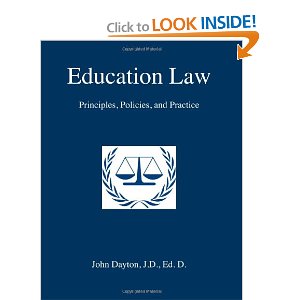
But, recently I was made aware of a new textbook on education law that takes a different approach to publishing, namely, no publisher. John Dayton's new book, Education Law: Principles, Policy & Practice, has taken a self-publishing approach. It is a very comprehensive (480 pages) look at education law. It is also not a casebook, meaning John actually wrote all of the text. There is also a Kindle version coming soon. I have just briefly scanned the book and find it to be very well constructed and particularly strong on constitutional issues. It was clearly a labor of love and I recommend you at least give it a look on Amazon. To those folks teaching law out there, I'm sure if you contacted John he could get you part of the book to review even.

What is really interesting to me about the book, though, is that it signals a new potential path for publishing that changes the game. How, you ask?

(1) First, this type of publishing keeps costs much lower. So much of the price of a textbook is wrapped up in the publisher's overhead costs and not in the actual printing of the book. Pearson, all of those teaching in universities know, has an enormous staff. I have a personal Pearson representative that stops in my office about every three months. That is a salary John Dayton does not have to pay, nor does Amazon, nor does the start-up partner CreateSpace, and most importantly nor do any customers. In essence, all the cost of this book entails is the compensation for the time John spent writing it, the very small amount he paid CreateSpace to help with the process, and the cut Amazon takes. The author, usually the professor, is not in this for the money. There is some money, don't get me wrong, but ask your standard textbook author whether they care about the royalties and I bet they do not. There are so many other, and better, reasons to do it anyway (although I'm not sure vita-boost counts as better). Nevertheless, very few professors are motivated by the royalty money. Bottom line? 

Most popular text in education law: $172.30
Second most popular and one I favor: $110.99
This new textbook: $35.99 

Ask your students out there which one they favor. 

(2) Copyright. As an author, when you work with a standard publisher you lose the copyright to your work. The publisher holds and controls the rights to the future use of the book. This is a bad thing for everyone but the publisher. When a book runs initially, I do not mind the publisher recouping their costs even with a little extra added on for profit. What I do mind is the publisher keeping the rights of that book under lock and key long after their investment as been paid off and the book is marketable. Standard copyright these days is around 100 years. Thus, any traditional book (or journal article for that matter) is useful only while marketable and only to those capable and willing to pay the price (see #1, above).

Take away this traditional copyright game, however, and a whole new world opens up. An author has so many more options both in the near term and in the long term. The author can share the book with whomever he/she pleases. Can choose to use it in their own classes free of charge. Can partner with professional organizations to make snippets public. Can create websites that do so many different things. Can put the text out in ePUB, so it is digital and interactive. Can update the text whenever. And on and on. The long-term, though, is even more interesting to me. Once an author recoups the initial costs, why not release the text to the public with a Creative Commons license? Let the world share and remix and build from the text? Why not? So many awesome possibilities ... that are not behind a 100 year firewall.  

(3) Flexibility - When I write my textbook, I am going to put YouTube videos in it. No, not as some add on CD or some outside website with a crappy URL ... I mean seriously right in the text, sometimes in place of the text, right there seamlessly in the book. Why try to describe Savana Redding's case when she can describe it for herself? Seriously? When the few (and believe me, still few) publishers that have solicited me to write for them hear this, their eyes get really big and they cock their head a bit in confusion and look for an exit. But, I am serious. Traditional publishers ... are traditional. Print offers very little flexibility. Black, white, 8 1/2 x 11 ... that's about it. Digital text is different.

Ultimately, why I wanted to write this post is just to let you know it is okay to think differently about publishing. To have different expectations of authors, publishers, booksellers, and consumers. The inertia in the traditional publishing model is deep and long-lasting. We are going to be printing books in publishing houses for a great while longer. But, it is not the only model now. In niche fields like ours, it may not even be the best model. Certainly this book is a test case and we shall see in a few years the results. But, whether or not this effort is successful, it will not be the last effort (yes, that is a personal promise). Information is different now and it needs to be treated differently. This was one bold step forward along that path.

Bravo, Professor Dayton. Thank you for being a leader.    

Monday
Dec122011

McCarthy on Student First Amendment Rights and Cyberbullying

My mentor and titan of the field of education law, Martha McCarthy, rarely makes video appearances. So, we have to treasure the few that we have. Recently, she was installed as the new Presidential Professor at Loyola Marymount University. As part of the introduction, she gave an hour or so lecture on student expression issues, particularly online expression and cyberbullying. It is a great watch for the content, but it is an even better watch to get a sense of her teaching ability. As you can see from the video, it was a fantastic learning experience to have studied under her. 


Thursday
Nov032011

I'm Still Alive (Very Much So, In Fact)

I need to update some things around here. So here goes: 

Personal Updates: 

1. I'm writing for a new blog at BigThink called Education Recoded. It is sort of a second generation project for me as I am really beginning to find my unique voice. The title I think sort of sums up my intentions there, so read this post as to the great project I'm undertaking. BigThink has a mass audience, so it is a pleasure and honor to write there (I promise I'll keep writing here as well).

2. I have some new model legislation out on virtual schooling. Check that out. Thanks to NEPC and their leaders Kevin Welner and Gene Glass for including me. That was a fun project. I have some more on virtual and supplemental online education coming out soon, so I'll update on that as well. 

Team Updates: 

The CASTLE Directors at UK. This team is rocking! 1. CASTLE. We're rolling now. Scott has a new book out. We have a new policy brief series, the first of which went up last week. Two of our directors are doing consulting work in Cambodia as I post this with additional countries under negotiation. We are hosting 2 outstanding visiting scholars this semester. We are building an outstanding staff. We are on the cusp of launching new programs at UK (couple more approvals to secure). It is going as well as I could have hoped for and we are just getting rolling, so ... smiles. 

2. Law and Policy Group. As I've mentioned on here before, we have an extremely strong education law and policy group at UK and that group is finding their footing and starting to produce results. Our first conference last year was successful, so we are doing a second so if you are in or around Kentucky, come check that out. Also, Neal Hutchens has led the effort to develop a new refereed journal, the Kentucky Journal of Higher Education Policy and Practice and, of course, don't forget the new higher education group blog that is rolling along impressively: HigherEducationLaw.org.  This group is starting to come together nicely. 

Site Updates: 

1. I changed the commenting platform to Disqus. I hate to lose access to all the old comments (I still have access if you need them), but the spamming was killing me and I think Disqus is a better filter for that kind of stuff. Plus, Disqus is a much more powerful platform. You can login with multiple existing web ID's and you can track and reply to comments even across multiple different blogs and platforms. It is a huge improvement, so it was time to pull the trigger on that. 

2. I've disabled much of the page content I had at the top. With all the other stuff already mentioned in this post and in my push toward tenure over the next year or two, I do not have time to keep all of those updated and accurate. So, for now at least, I think it is best to just put those on hold. 

Tuesday
Aug232011

Missouri: Enter the ACLU

Well, this was just a matter of time. The ACLU is suing the state of Missouri against their Facebook law. 

Actually, you have to give the ACLU some credit lately. They are also watching schools for limiting some speech by blocking certain websites in a discriminatory fashion. Just in Missouri this last week the ACLU got a consortium of districts to unblock some pro-LGBT sites that they had been blocking. 

You can think what you want of the ACLU and there has been occassions where I have disagreed with their positions, but for now the ACLU seems to be on the side of proper and healthy technology integration in schools. 

Wednesday
Aug102011

An Education Technology Policy Job

As Policy Director at iNACOL - a professional association and advocacy organization for online learning, and a large player in the Virtual School environment. I would really like to see an educational lawyer in this job - and in particular one that has some touch with the educational law scholarly community ... so, I thought I would post it. 

Fellow CASTLE blogger Michael Barbour sent over the tip (for more info and a different take on the position, read the comments). If you have any interest in virtual schools or other online learning in K-12, he absolutely needs to be in your Reader. 

Friday
Aug052011

Kentucky ... You're Next

Kentucky ... We. Are. Coming. After. You.

Man the Cannon! Button down the Hatches! Hide the Children if you Must!

This is fair warning to each and all that proscribe to traditional education in Kentucky. You are in our sights ... and we are planning to bring the thunder.

This is just a snippet of what we do to states we have our eye on.


I am so, so proud to say that on this Leadership Day 2011 ... CASTLE has landed in Kentucky. We are here. We are ready. And we are going to drive change whether you like it or not.


#leadershipday11

Kudos to Scott McLeod & the Iowa Future Group for putting #5 together, as well as the incomparable XPLANE for doing the graphics and video. Scott explains and thanks here. While there are no current plans for a Kentucky version, we are beginning the conversations about raising some capital to fund it (if you are willing to help, please let me know). The Kentucky team has already released this STEM version, so you can get started there.

Thursday
Aug042011

My First Thought About Missouri's New Social Media Law ...

was that I am really, really happy I am not teaching at Mizzou right now (which was under discussion at low-levels at one point). I'm serious. That was my first thought. Not only do I not want to deal with this in my job, but more importantly, I don't want my kids in those schools. My sister went to Mizzou. It's close to home for me. I am a Cardinals fan to the core. And, I like that university and always held it as a place I could see myself at for the long-term. But, my first thought in seeing that new law ... glad I'm not at Mizzou.  

These kinds of decisions have real-life consequences, beyond even the present-day high-school classroom. This kind of stuff sends a message of who you are and who you want to be as a state. How can you be serious about trying to build a high-tech sector in Saint Louis when your leaders make statements like this one? How can you be serious about trying to keep your best and brightest in-state, when you are sending messages that you are going to restrict how the best and brightest talk to one another? 

Ultimately, these types of decisions, time and time and time again, are why Saint Louis is not Chicago (it should be, if you didn't know, but instead now-a-days I see it more frequently compared to Detroit). This is why the Washington University grads want to go live in New York or Chicago or California. Ultimately, this is why places lose in the global competition. South Korea is putting technology as fast as possible into student's hands ... Missouri is taking it away. So, why do economic numbers surprise us again? 

And, circling back, because I've kept my eye on them, I know that Mizzou's education leadership program has lost a lot of really good, young faculty members over the last few years. I can't help but think these types of things are related. 

Tuesday
Jul052011

Education, Law & Copyright

Here is my latest lecture. This was delivered originally at the KASA Law & Policy conference in June. I rerecorded it for Education Law Association purposes, as I will be doing a podcast for their project to get podcast coverage of most topics in education law. 

Saturday
Apr162011

Good luck with that, YouTube

YouTube is trying to get tougher on copyright violations. Here is their latest attempt at "education." 

Hard to believe that YouTube thinks this kind of stuff will be effective, but at least it might protect them against copyright cases against them a little. 

It just speaks to how remarkably out of touch copyright law is in the United States. We do have to protect the financial interests of the creators, but we need mechanisms to permit the kind of reuse and remixing that your average kid would engage in. "Fair use" in the pre-Internet era must be different than fair use in the Internet era. 

I don't expect Congress to change anything anytime soon, so we will continue to see this kind of ridiculous exercise in the future. 

Wednesday
Mar232011

Facebook is the Local Newspaper Now ...

Facebook is the new local newspaper ... in case you hadn't noticed. 

Case in point ... the Pinckneyville Post today. The "Post" publishes an actual newspaper (I've seen it, it is about 10 pages long, typical newspaper size, typically 2 actual stories, obituaries, classifieds and not much else). You should know that Pinckneyville is one town south of where I grew up and it is my wife's town, actually, which is why I follow it. It has 5,000 some people, but only 3,000 some real residents because it has a prison which adds to the population. In addition to the actual newspaper, it has 2,000 Facebook followers (I can only assume that exceeds their paper subscriptions). 

This discussion took place on Facebook today. Give it a quick glace, but here is a summary. The transportation department removed one of the signs leading into the city that had been there for several years that celebrated a high school track champion for the state of Illinois. The newspaper did its investigation and posted the results on the Facebook page, along with the photo. Then, 25 comments later (so far) a group of saddened local residents had decided to petition the local high school board to name the new track after the girl (as well as find and give the old sign to the girl). 

This is a really, really, really common thing on Facebook and this is a super insignificant incident anywhere outside of Pinckneyville, Illinois. But, that's the point. And it is one that school officials need to understand. Facebook is the local newspaper now. It is also the local gathering place. It is the local front steps of the Courthouse, too. It is all that, and more, wrapped up into a single technology that makes democracy easier.

Monday
Jan242011

Interactive Snowday Notification

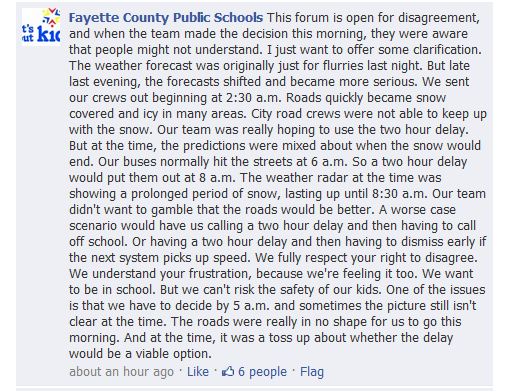
One of the things that has caught my eye this winter is the use of Facebook to notify parents of school closures. In particular, the comment option on Facebook posts has be used frequently by parents to give their two cents on the decision. Today, for instance, my local district, Fayette County Public Schools, has cancelled. It's borderline today (my kids preschool stayed open), so the comments are pouring in and the discussion is intense.  

I've noticed that districts have been dealing with this differently on their Facebook pages. Consider that FCPS is responding to some, not to others, but doing so from a professional district account. Also, the responses are coming from FCPS' PR department. After a series of tough comments on the decision, FCPS made this response: 

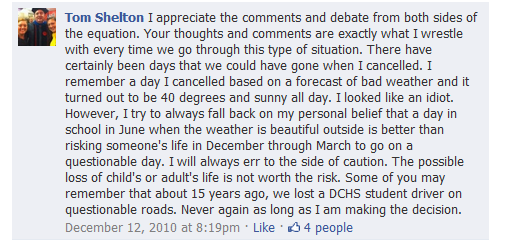
A different way of dealing with this comes from another large district in Kentucky, where the Superintendent himself posts the notification and responds to comments (and gets the spam): 


Of course, other districts can either post nothing at all, or just refuse to respond to comments. I'm not sure what the best procedures are, but it has been extremely interesting this year (because of the frequency of snow days and the tipping point Facebook has seemed to cross). Either way, it is a very interesting new conversation taking place between school officials and their communities. 

Even though there is lots of potential for abuse and legal issues, generally, I think this is a good thing. And, if this is the icebreaker (pun intended) for districts utilizing Facebook pages more broadly both with communities and with students, then I am happy to see it. 

Monday
Jan102011

Should State Boards of Education Issue Guidelines?

Today, the Virginia School Board is considering adopting a set of guidelines on teacher electronic communication. The "guidelines" cover everything from texting to online gaming ... basically, they say teachers can never talk to students using electronic communication. If they do, for an emergency or whatever, they need to report it to their supervisor the next day. 

Obviously, I am going to hate the merits of this set of guidelines. They are simplistically stupid - as in this is an attempt to apply simple rules to complex situations - in addition to just making me think the board members are a bit simple-minded.

But, outside of the merits, these sort of guideline prescriptions of model policy have always bothered me. State Boards are regulatory agencies tasked with passing administrative law extending legislatively created statutes. So, I don't see this in the job description.

It winds up being, of course, a policy back door. You can get schools to do what you want without having to go to the trouble or burden of passing regulations. And, then, just like the Federal government, you say that schools have a choice, even if it is a politically or financially unrealistic choice.

It's coercion, simple as that. Is that what we want from our democratic systems? Are both legislatures and schools so screwed up that state agencies are forced to intervene with coercive, legally-questionable model policies because neither can accomplish the correct outcome (questionable anyway) through traditional legal means?      

Thursday
Nov112010

Education Technology Law Preconference - Notes

Well, the education technology law preconference session seemed to proceed decently. We covered the hours with a healthy discussion amongst administrators, lawyers and professors and several very difficult legal issues made more difficult by technology. This post just serves as a collection of notes that we talked about during the preconference. 

The powerpoint. (ppt) (pdf) - (these are big files)

Some News Stories We Cited: Charlotte Facebook Issues | Murmer's Butt Art | BullyPolice

Some Cases we Used:
Klump v. Nazareth
 | Doninger v. Neihoff | Requa v. Kent Sch. Dist. | Doe v. Conventry Sch. Bd. | Garcetti v. Ceballos | Price v. NYC Bd. of Educ. (cell phone ban case)

Other Stuff
Creative Commons | Foursquare | Twitter | My Twitter Feed | the Example Twitter Feed (Nordeer) |  ELA's Twitter Feed

Thanks to all that attended. If you have other questions or want links to other things, just let me know. 

Tuesday
Sep142010

"Flipping" Ed. Law Instruction

My friend Karl Fisch was featured by Daniel Pink in a story in the Telegraph on Sunday for flipping his instruction such that students do lecture at home and homework at school, instead of the more traditional lecture at school and homework at home. I thought it was a great story and I highly encourage you to read it. 

But, I wanted to use it to point out that for the last 2 years, I have been using the same model in my education law instruction and I wanted to encourage everyone else to consider doing the same.  This model of getting the content done before they come to class and doing homework and activities in class seems to work really great in our field.

First, we actually have specific content knowledge students need to know, such as what their state immunity provision says. Second, though, much of that content is quite boring (even though weirdos like me find immunity statutes fascinating). Third, that content is quite specialized so we rely heavily on textbooks. Fourth, there are few ways to assess that specialized learning outside of class, so the assignments are dull. And, fifth, that leaves us little choice but to wind up with some type of exam as the main assessment. 

Education law is a perfect candidate to be flipped. Get the content online. Record lectures (I can help you learn how, if you like) and post them. Then build readings around them. You can still rely on the textbook (although I would discourage it), but link to the Constitution. Link to cases. Link to summaries. Link to blog posts. Link to news stories. Link, link, link. Once you get enough links, you'll realize the textbook is not as important anymore. Also, let the students have their initial discussions online. Get the basic questions out of the way. If you must, like I do, build in an online quiz to assure students do the reading and the videos. 

Okay, now, all that work you would have done in class is over with. Now is when things get really fun. In the class meetings (of which you now need fewer) do the homework - the activities, the discussions, the modeling and everything else that reinforces the learning that occurred online. It is much more fun that way and the quality of the course improves. While you have them, you can build points around all those activities, so suddenly you realize you don't need an exam. There are plenty of ways to assess learning formatively in real time as the course is happening and those things add up to enough points that an exam is not necessary. 

Granted, flipping the course like this is more work. Now, instead of just lecturing, assigning textbook chapters and writing and exam, you also have to plan activities, manage technology, write on discussion boards and provide more formative feedback, among other things. But, that is the kind of work that actually takes learning to another level, from consuming to engaging. 

Anyway, I've been doing it a couple years and I am never going back. And, if you are interested, there are plenty of resources to help you ... including me personally. Hope you give it a try.